BBoE: Leveraging Bundle of Edges for Kinodynamic Bidirectional Motion Planning
1University of Colorado Boulder
IEEE Robotics and Automation Letters (RA-L), 2026


1University of Colorado Boulder
IEEE Robotics and Automation Letters (RA-L), 2026

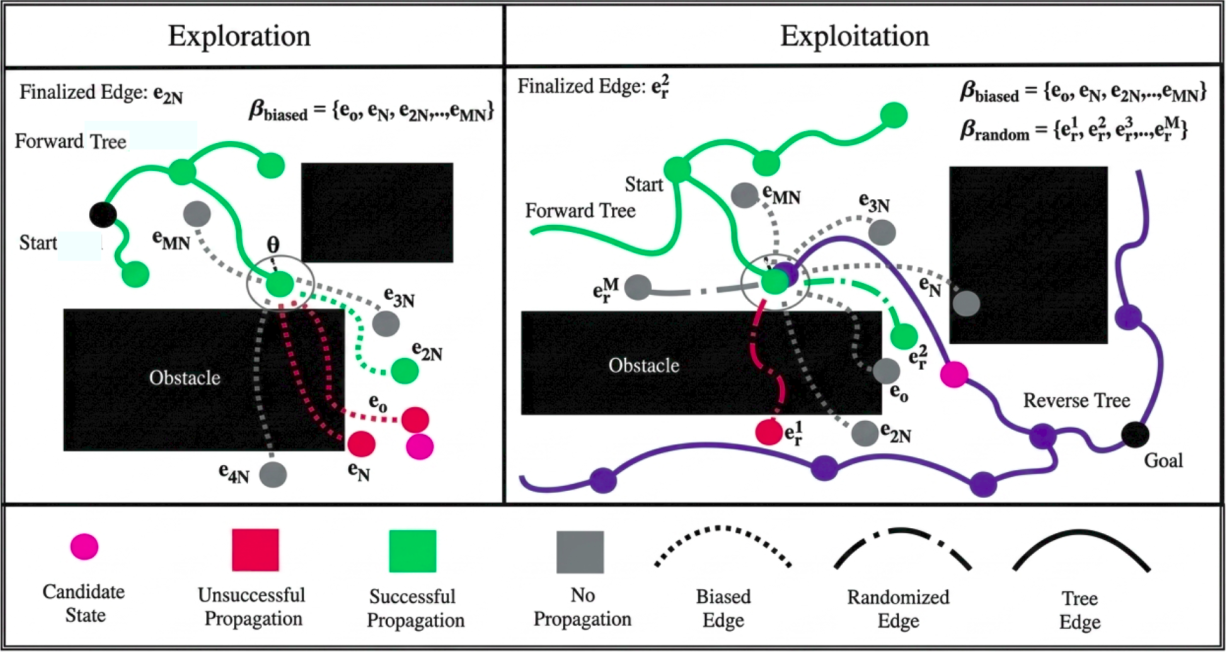
In this work, we introduce BBoE, a bidirectional, kinodynamic, sampling-based motion planner that consistently and quickly finds solutions in environments with varying obstacle clutter. The algorithm combines exploration and exploitation while relying on precomputed robot motions, resulting in efficient convergence towards the goal. Our key contributions include: i) a strategy to quickly find solutions in obstacle-rich spaces by leveraging a bundle of precomputed robot motions (i.e., edges); and ii) BBoE, a robust bidirectional kinodynamic planner that utilizes this strategy to produce fast and feasible solutions. Across four systems spanning 3D to 6D state spaces, BBoE is the only planner to achieve ≥ 96% success on every system while attaining the lowest planning time on three of four.
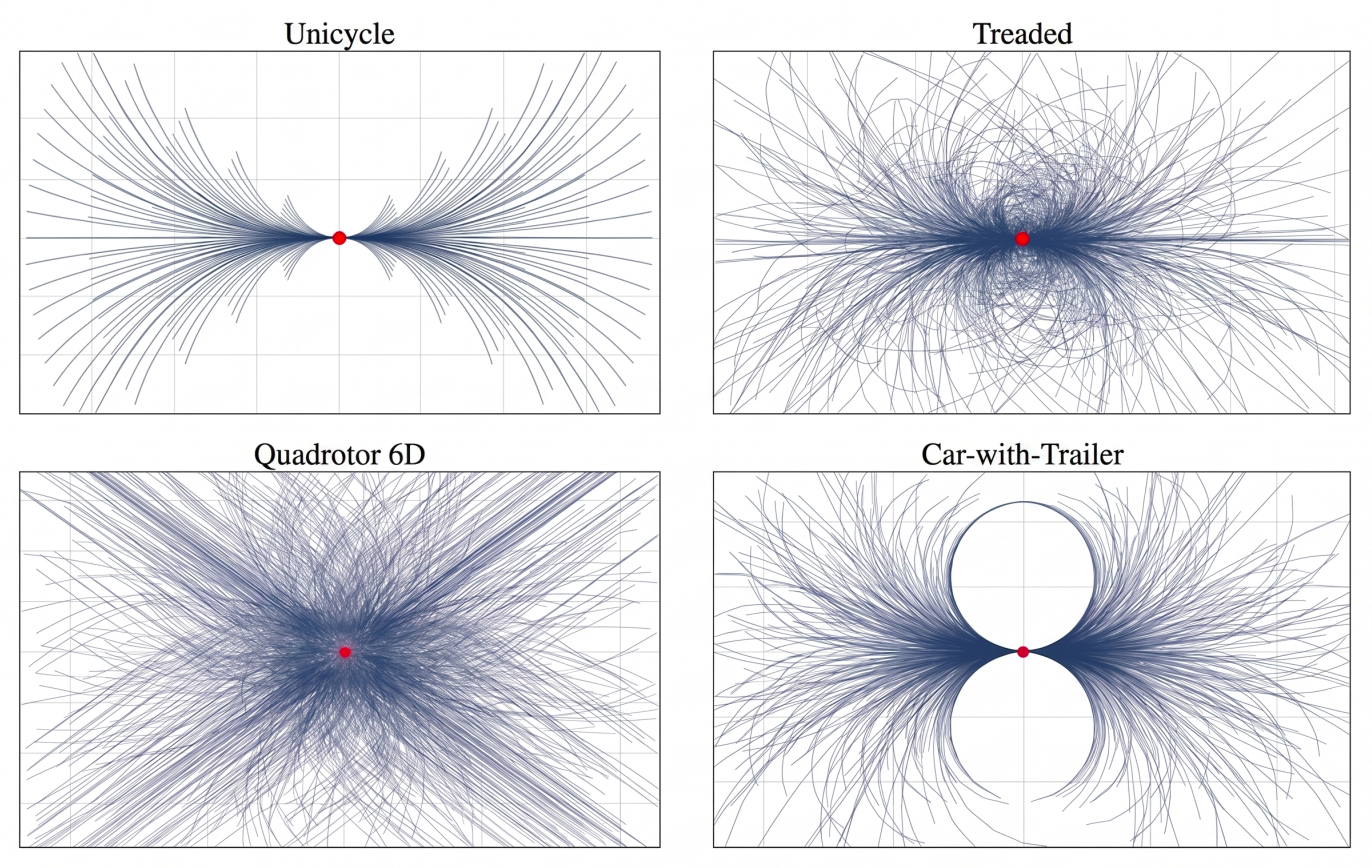
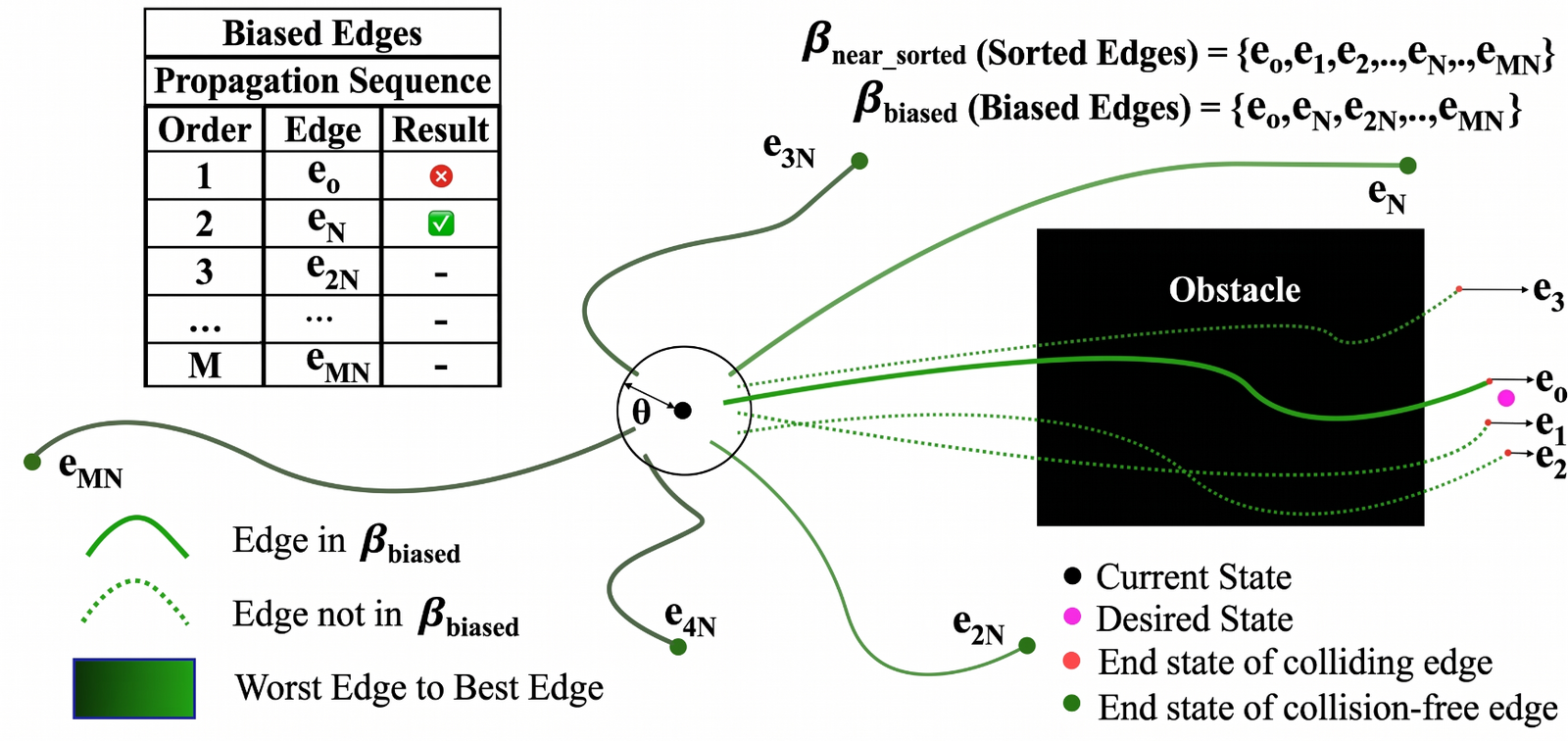
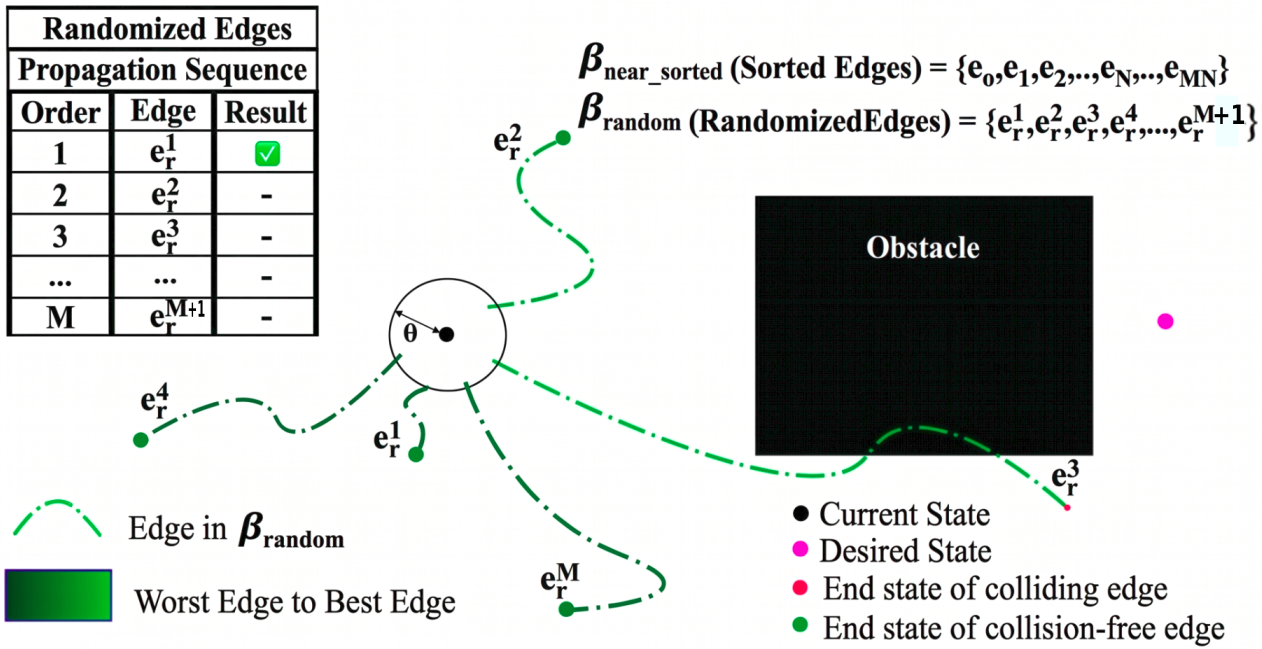
Kinodynamic planners usually generate motions online, either through steering functions, which are expensive and hard to define for complex systems, or through Monte-Carlo forward propagation, which wastes effort in clutter. BBoE instead precomputes a large bundle of edges offline: short, dynamically feasible motions obtained by applying random controls for random durations. At planning time, the edges that start near the current state are transformed onto it and reused. Pose components are transformed away, so the bundle only needs to cover the kinodynamic subspace (velocities, steering and hitch angles), which is why 190 edges suffice for the unicycle and 50,000 to 100,000 for the 5D and 6D systems.
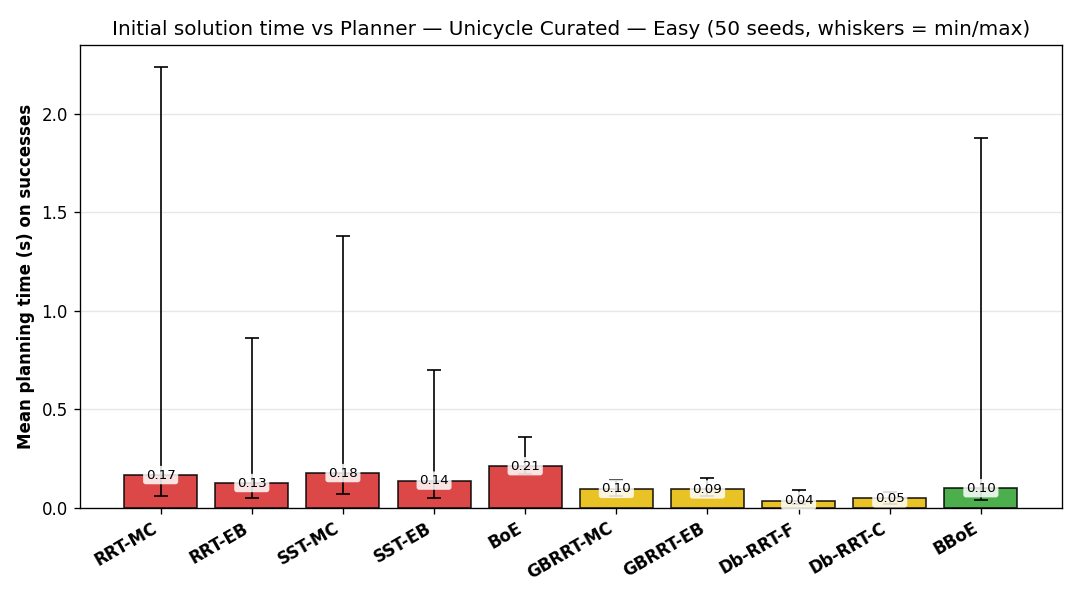
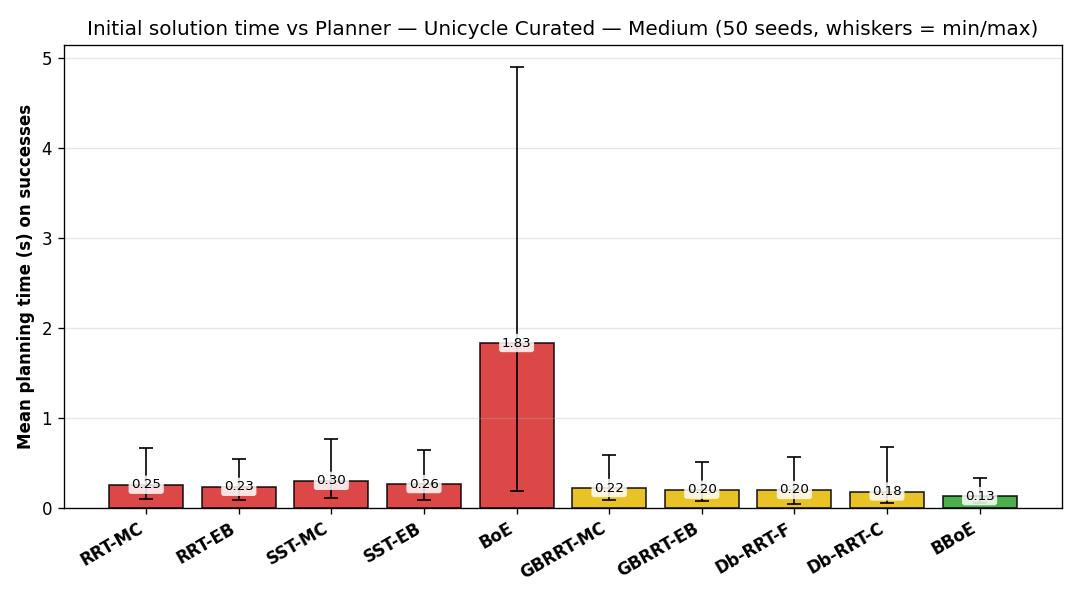
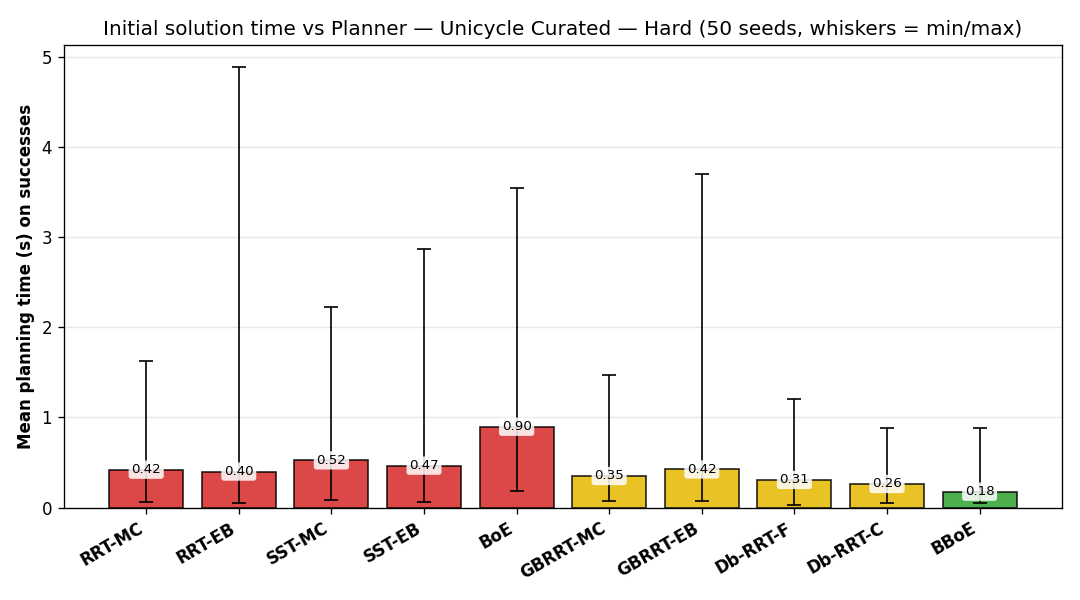
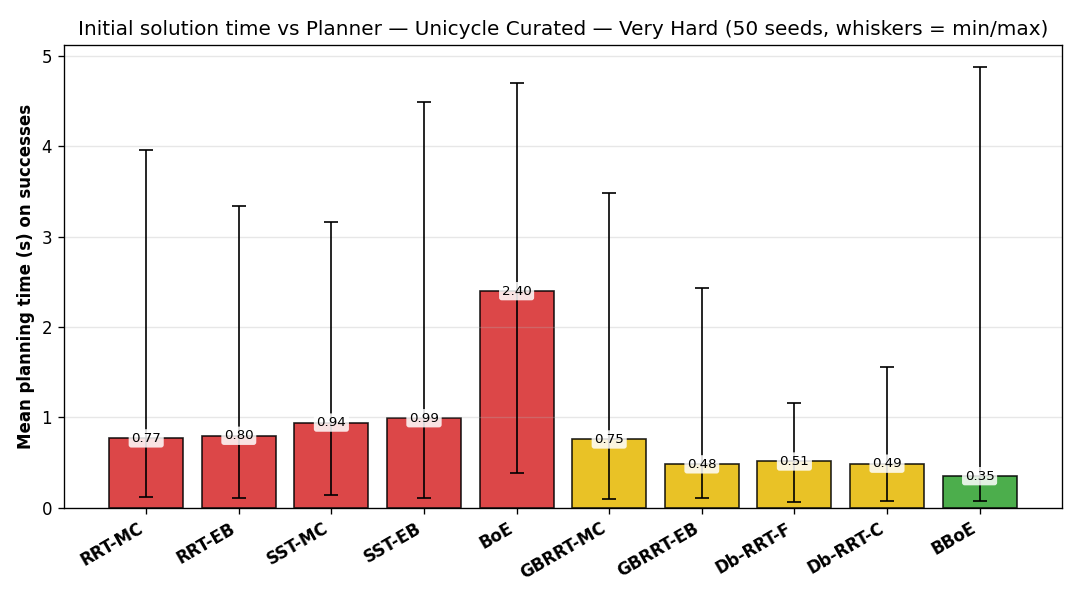
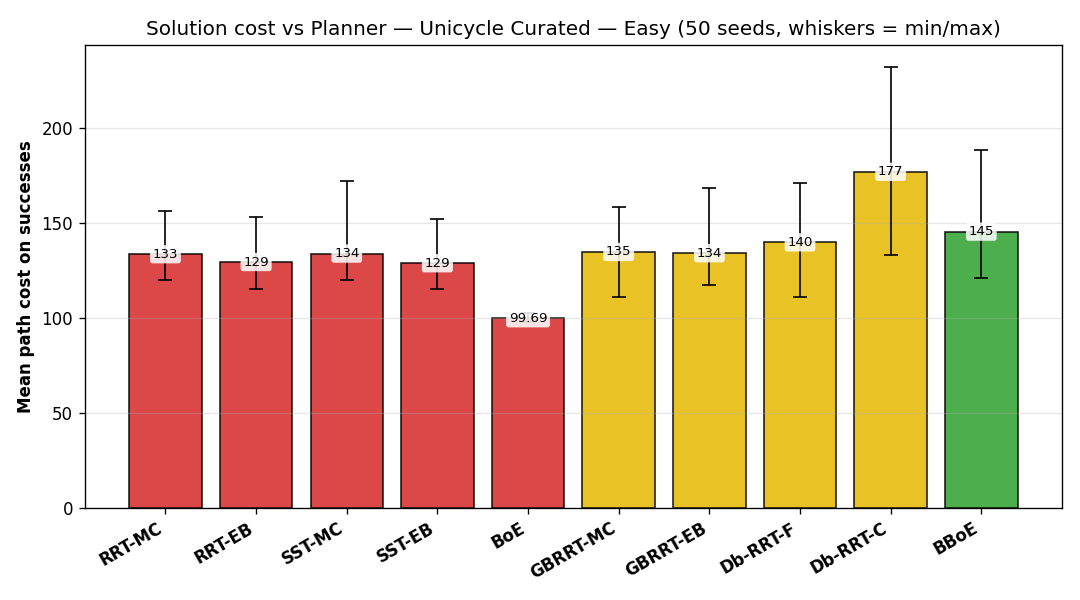
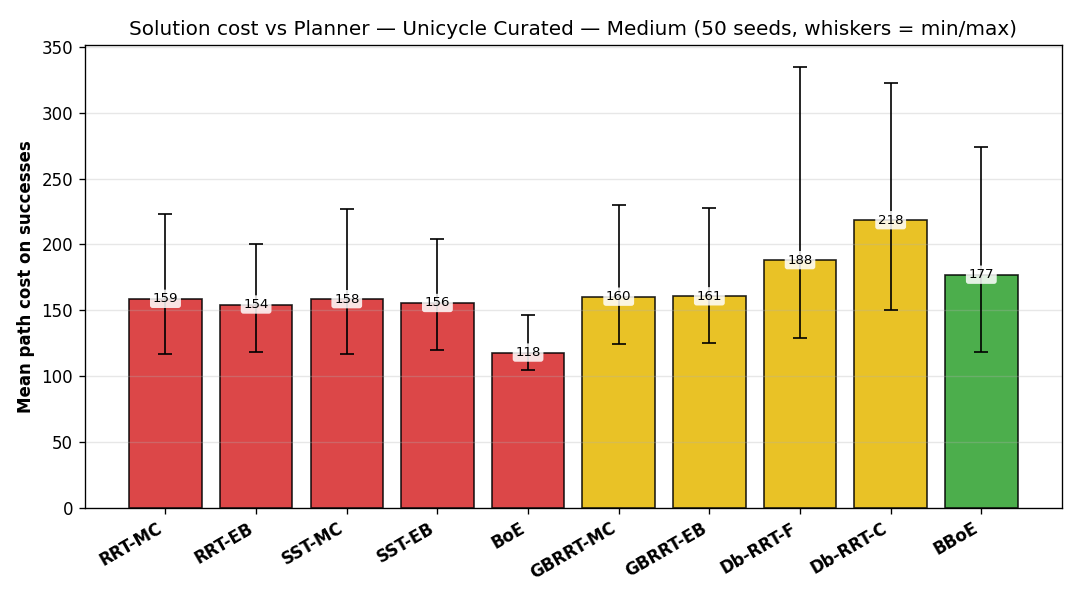
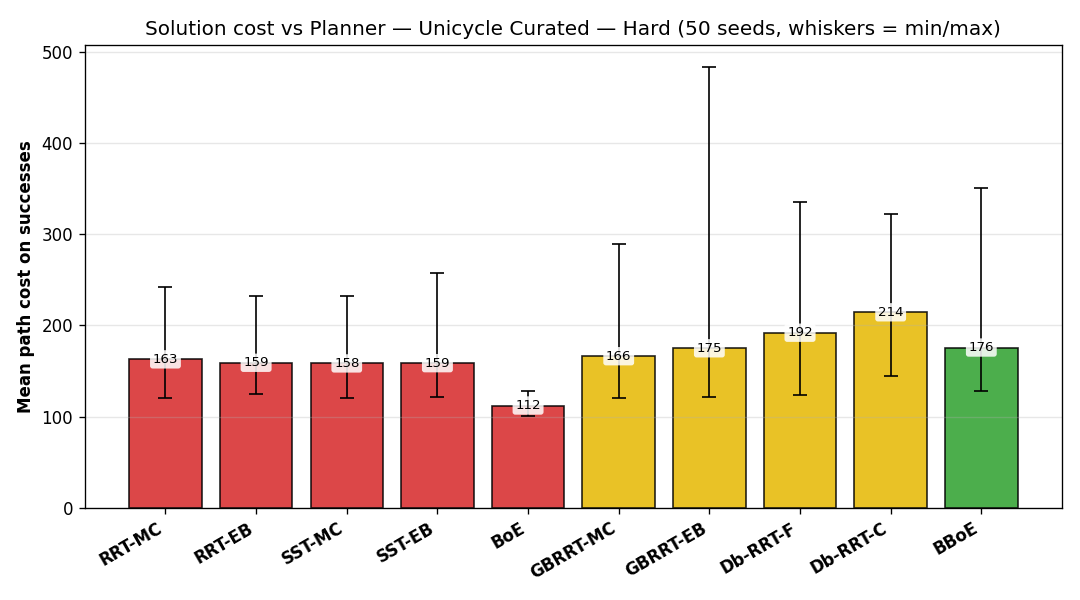
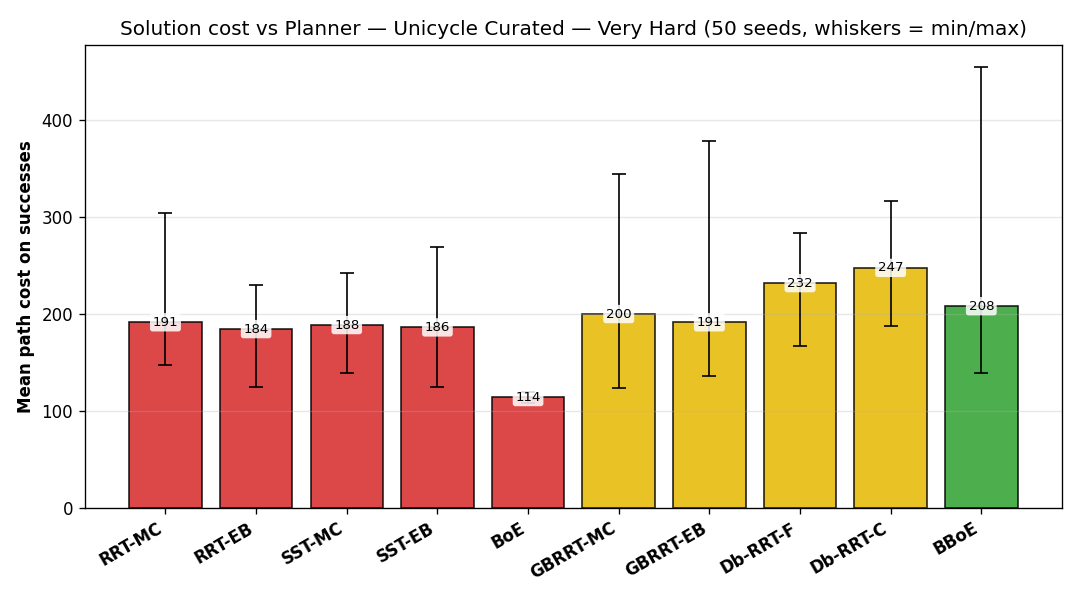
All planners share a 5 s budget per trial, 50 random seeds, and, where applicable, the same edge bundle. Baselines: RRT, SST, GBRRT (each with Monte-Carlo and edge-bundle variants on the unicycle), BoE, and the search components of dB-RRT-F and dB-RRT-C. Columns E, M, H and VH are the easy, medium, hard and very-hard unicycle tiers, each 10 randomly generated environments; Uni, CWT, Tr and Qd are the fixed unicycle, car-with-trailer, treaded-vehicle and quadrotor environments.
| Planner | Easy | Medium | Hard | Very Hard | Unicycle | CWT | Treaded | Quadrotor |
|---|---|---|---|---|---|---|---|---|
| RRT | – | – | – | – | – | 96 | 80 | 90 |
| RRT-MC | 100 | 100 | 92 | 88 | 100 | – | – | – |
| RRT-EB | 100 | 100 | 100 | 90 | 100 | – | – | – |
| SST | – | – | – | – | – | 100 | 82 | 52 |
| SST-MC | 100 | 100 | 100 | 82 | 100 | – | – | – |
| SST-EB | 100 | 100 | 100 | 88 | 100 | – | – | – |
| BoE | 100 | 62 | 60 | 18 | 48 | 0 | 96 | 0 |
| GBRRT | – | – | – | – | – | 100 | 88 | 88 |
| GBRRT-MC | 100 | 100 | 98 | 100 | 100 | – | – | – |
| GBRRT-EB | 100 | 100 | 100 | 100 | 100 | – | – | – |
| Db-RRT-F | 100 | 100 | 90 | 52 | 100 | 86 | 78 | 24 |
| Db-RRT-C | 100 | 100 | 96 | 70 | 100 | 98 | 100 | 48 |
| BBoE | 100 | 100 | 100 | 100 | 100 | 100 | 96 | 96 |
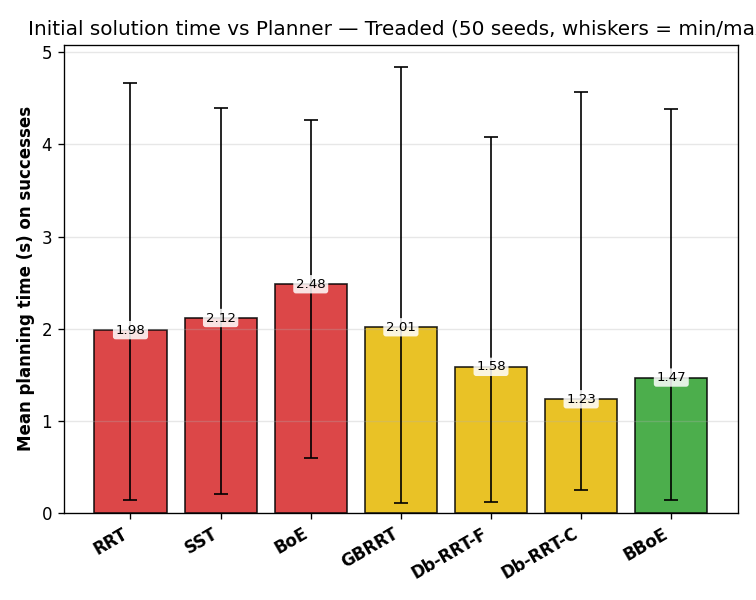
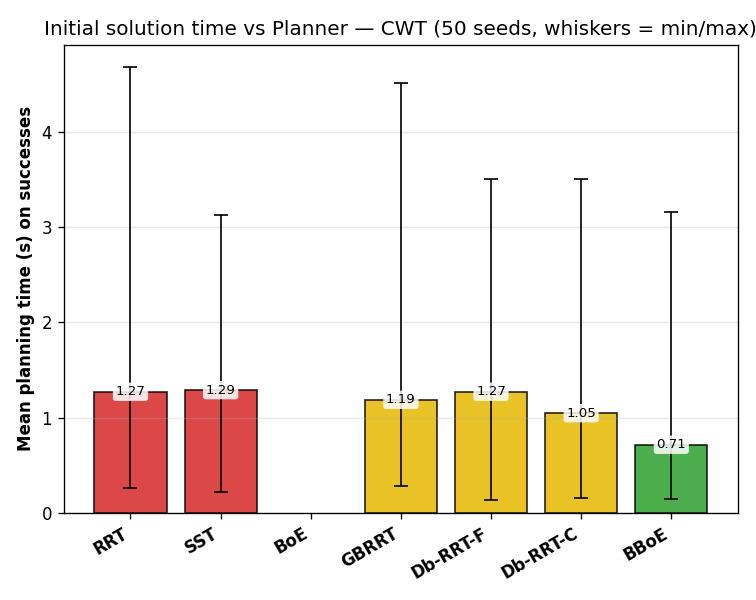
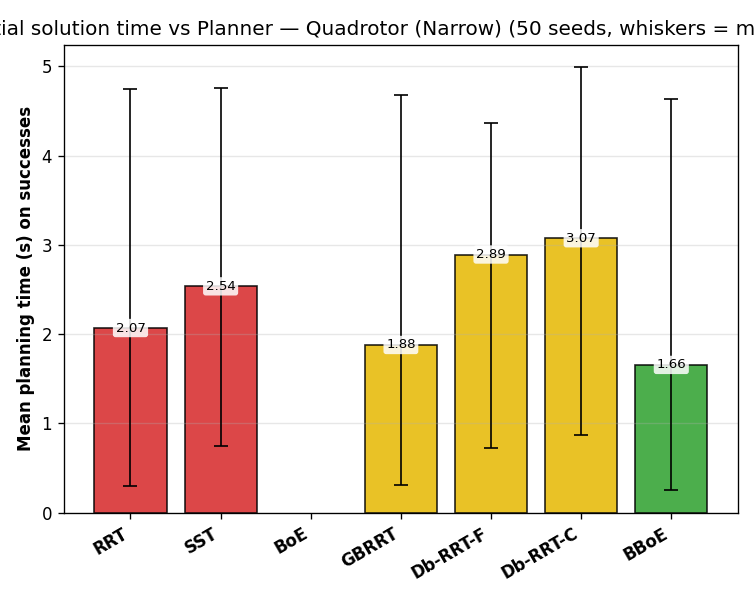
Mean initial-solution time (top) and mean solution cost (bottom) over successful trials. BBoE reaches 0.23 s on the unicycle, 0.71 s on the car with trailer and 1.66 s on the 6D quadrotor in a narrow-passage environment, and stays within the 1.2–2.0 s cluster of bidirectional planners on the treaded vehicle.
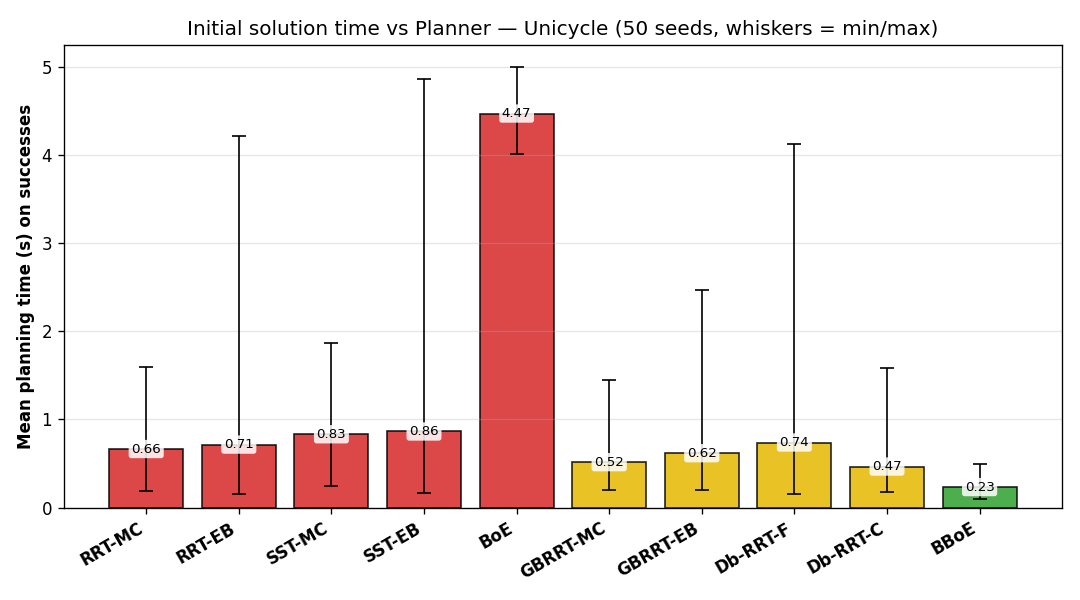
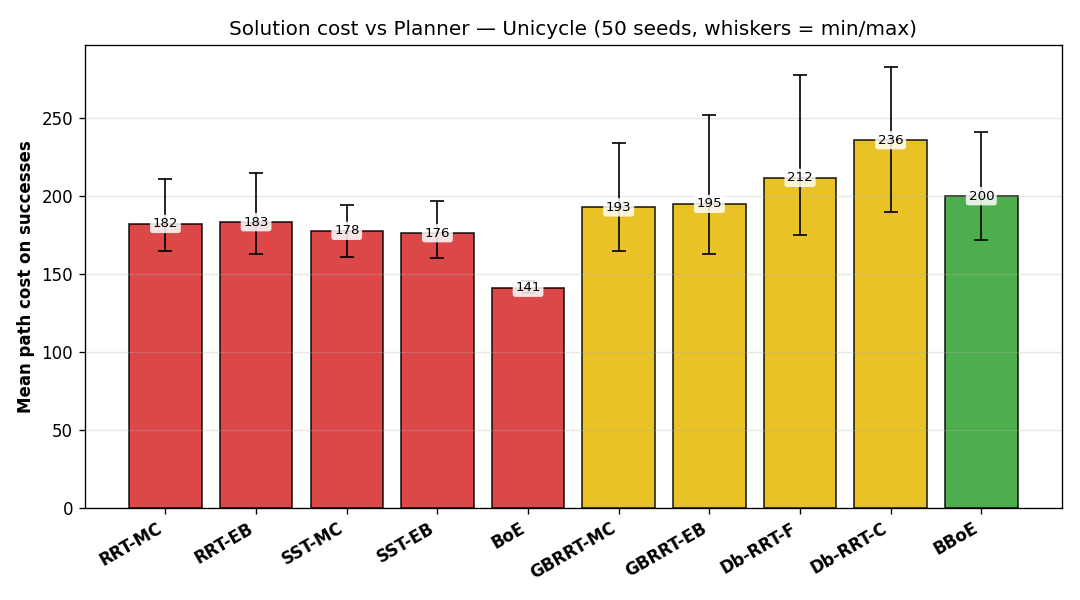
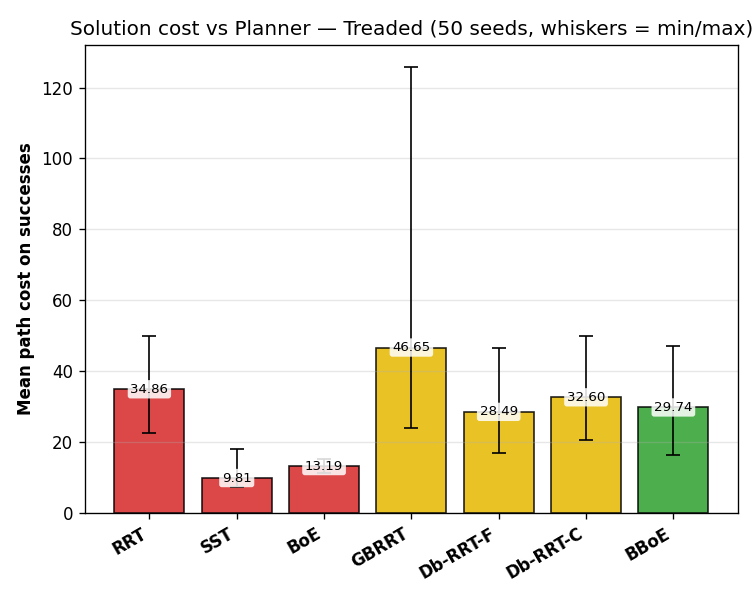
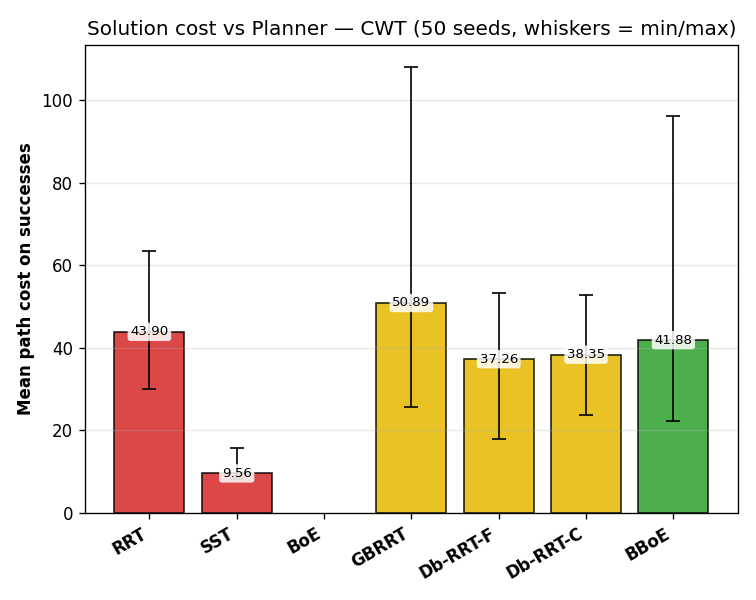
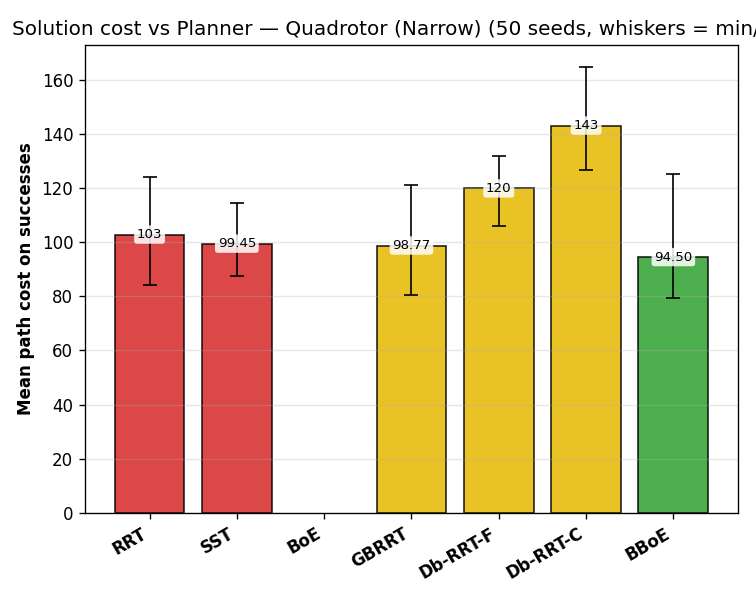
On the unicycle, BBoE becomes the fastest planner from the medium tier onward (0.13 s medium, 0.18 s hard, 0.35 s very hard) while keeping 100% success, and the gap widens with clutter: on very-hard environments it is about 1.4× faster than the next-best GBRRT-EB, while the dB-RRT family drops to 52% and 70% success.
Forward tree in blue, reverse tree in red, final solution in green. Each clip is one planning run until the first solution.
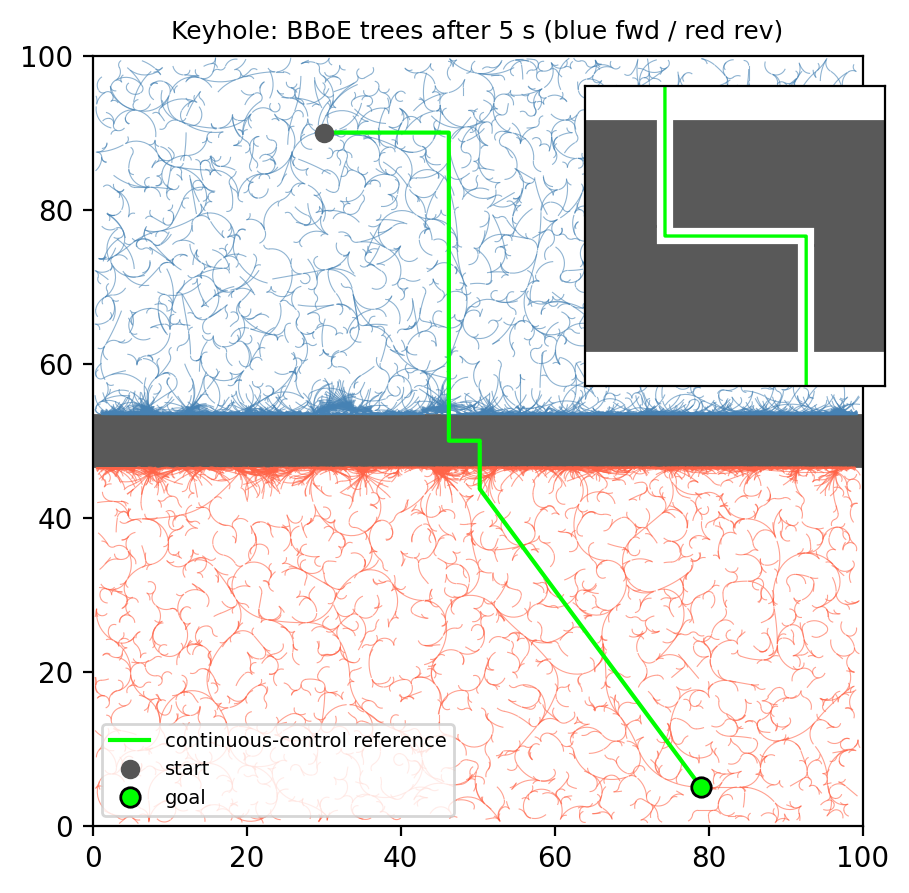
For a fixed bundle, BBoE is probabilistically complete with respect to the graph the bundle induces, but not over the full state space, and it claims no optimality. Its failure mode is a coverage gap: a passage that requires a maneuver absent from the bundle cannot be traversed regardless of the budget. The environment below makes this concrete for the unicycle. Its only passage is a pair of offset slots joined by a chamber with 0.12 m of free width, so crossing it needs a pivot in place or a turning radius under 0.1 m. The 190-edge maneuver library has neither (every edge lasts 1 s at 1 m/s or more, with a tightest turning radius of 0.64 m), so BBoE fails on all 50 seeds, while a hand-built continuous-control trajectory passes the same collision checker.
The planner, all baselines, the edge bundles, the benchmark scripts, and the logs behind every table and figure are released under the MIT license at github.com/brsrikrishna/bidirectional_bundle_of_edges_BBoE. Each benchmark is a single script with fixed seeds; the README lists the exact commands and the expected numbers.
@article{raghu2026bboe,
  title   = {{BBoE}: Leveraging Bundle of Edges for Kinodynamic Bidirectional Motion Planning},
  author  = {Bangalore Raghu, Srikrishna and Roncone, Alessandro},
  journal = {IEEE Robotics and Automation Letters},
  year    = {2026},
  note    = {to appear}
}